

 Ember Fasting
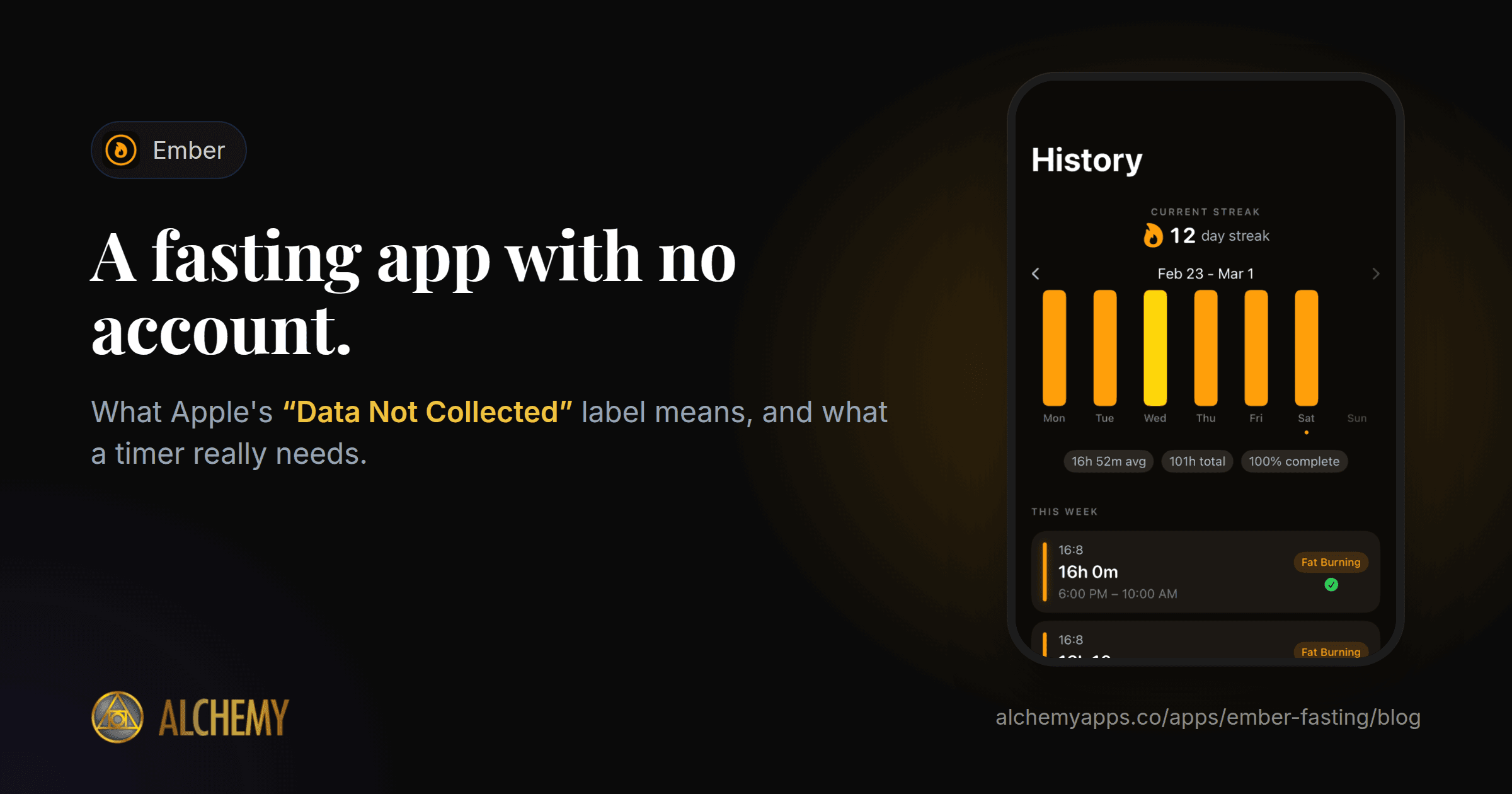
Many fasting apps ask for an email before they will start a timer. Some go further and ask for your weight, your goal weight, your age and your gender before the first fast. It is worth asking why a timer needs any of that, and where it goes once you type it in.
What a fasting app can learn about you
Even a simple fasting app sees more than you might think:
- When you eat and when you do not. Over weeks, that is a detailed picture of your daily routine.
- Your body. Weight, measurements and goals, if the app asks for them.
- How you feel about it. Mood check-ins, notes and journal entries.
- How you use the app. Analytics tools record which screens you open and for how long.
None of this is sinister on its own. But once it sits on a company's servers, it can be analyzed, shared with partners or exposed in a breach. Eating patterns and weight are personal, and for some people they are sensitive.
What "Data Not Collected" means
Every app on the App Store has an App Privacy section, written by the developer. It sorts data into three groups:
- Data Used to Track You: data linked with other companies' data, for example for advertising.
- Data Linked to You: data the developer collects and connects to your identity, such as an account.
- Data Not Linked to You: data the developer collects without tying it to you.
"Data Not Collected" means the developer declares that it does not collect data from the app. In Apple's terms, "collect" means sending data off your phone and keeping it longer than needed to handle a request.
Two honest caveats. The label is the developer's own declaration, so it is only as good as the developer. And Apple lets a few kinds of data go undisclosed, so read the app's description too: look for a plain statement that your data stays on the device. For a step-by-step look at reading the label, see how to check an app's privacy claims.
Why a fasting timer does not need an account
An account is useful when your data has to live on a server: syncing to a website, sharing with a coach, or keeping a social feed. A fasting timer needs none of that to do its job. Starting a fast, counting the hours, sending a reminder and keeping a history can all happen on the phone.
So when an app asks you to sign up before your first fast, it is fair to ask what the account is for. Often the answer is marketing email, analytics or a subscription funnel, not the timer.
The trade-offs
Keeping everything on your phone has costs too:
- If you delete the app, its history goes with it. There is no server copy to restore from.
- No web dashboard. Your fasting history lives in the app, not in a browser.
- No coach or community features that depend on sharing your data with other people.
If you want a coach to see your fasts, an account-based app may suit you better. If you want a timer and a private history, you do not need one.
Questions to ask before you choose
- Can I start a fast without signing up?
- What does the App Store privacy label say?
- Does it ask for my weight or body measurements, and do I want it to have them?
- Are there ads, and who are they from?
- Does the free version do what I need, or is the timer behind a paywall?
How Ember handles it
Ember needs no account. There are no ads, no analytics and no tracking, your data never leaves your device, and its App Store privacy label is "Data Not Collected". The full fasting timer is free, with the five popular schedules (16:8, 18:6, 20:4, OMAD, or your own), streaks, history and widgets. Ember Pro adds live metabolic tracking, extra widget styles, themes, icons and advanced notifications.
If you are still choosing a schedule, read 16:8, 18:6, 20:4 or OMAD: how to choose.
This is general information, not medical advice. If you have diabetes, take glucose-lowering medication, are pregnant or breastfeeding, or have a history of eating disorders, talk to your doctor before fasting.