

 Today's Pills
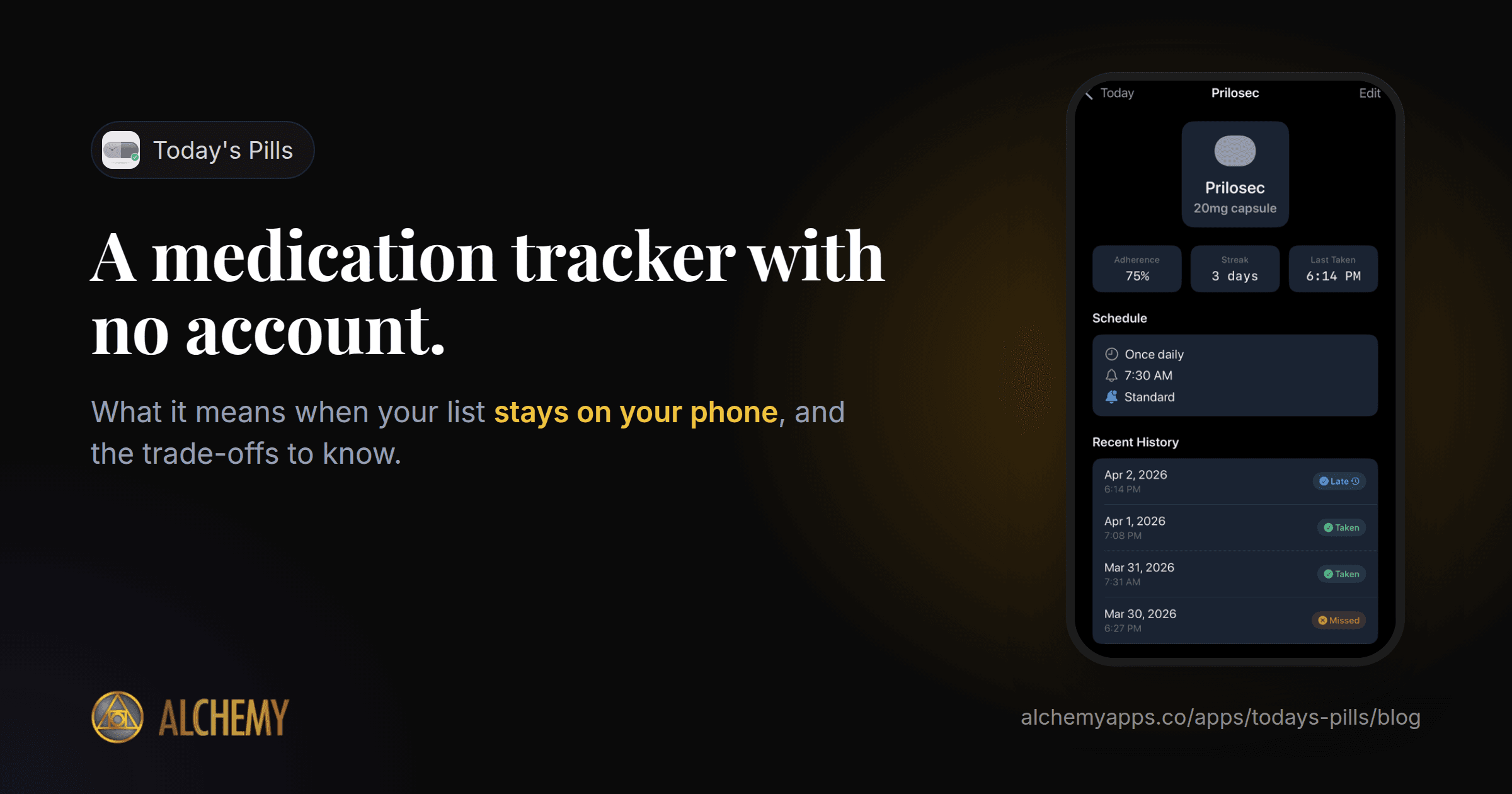
Your medication list says a lot about you. It can reveal a diagnosis, a mental health condition, a pregnancy or a chronic illness. Yet most medication apps ask you to create an account, and send that list to their servers, before they will remind you to take anything.
There is another way to build a medication tracker: keep everything on the phone. Here is what that means in practice, and what you give up.
What "no account" actually means
With an account-based app, your medication list is stored on the company's servers and linked to your email address. That is what makes features like caregiver sharing and web access possible. It also means your health information sits in a database you do not control.
An app with no account works differently:
- Your list is stored on your device. There is no server copy for the company to lose, sell or hand over.
- There is nothing to sign up for. No email, no password, no profile.
- Nobody else can read it. If the company does not have your data, it cannot be breached from their side.
How to check an app's privacy claims yourself
You do not have to take any app's word for it. On iPhone:
- Open the app's page in the App Store.
- Scroll down to App Privacy.
- Look at what is listed. "Data Not Collected" means the developer has declared it collects no data from the app. Labels such as "Data Linked to You" list exactly what is gathered.
Also read the description for words like "account", "sync" and "cloud". If an app needs an account to work, your data is almost certainly leaving your phone.
The trade-offs
Keeping data on your phone is not free of downsides. Be honest with yourself about these:
- If you lose your phone, you can lose your history, unless you have a backup or an export. Look for an app that lets you export your data.
- No automatic family sharing. A caregiver cannot watch your doses from their own phone unless the app shares data through a server.
- One device at a time. Without a server, your list does not appear on a tablet or a computer.
For many people these are fair trades. Your reminders and widgets all work offline, and you decide what leaves the phone.
Questions to ask before you choose
- Does it need an account to work at all?
- What does the App Store privacy label say?
- Can I export my data if I want to leave?
- Do the reminders get through Focus and Do Not Disturb? (Here is how to make medication reminders break through Focus mode.)
- What does the free version cover, and what does it cost to go further?
How Today's Pills handles it
Today's Pills stores all your data on your device. There is no account, no ads and no third-party analytics touching your health information, and your data is never sold. You can export your data as JSON at any time, so it is always yours.
The free version covers up to five medications, with Time Sensitive reminders that come through Focus modes, small and Lock Screen widgets and a 30-day history. Pro adds unlimited medications, escalating reminders, larger interactive widgets, a full adherence calendar and exportable reports to share with your doctor, after a 7-day free trial.
If your list is long, read how to build a schedule for five or more medications.
This is general information, not medical advice. Talk to your pharmacist or doctor about your medications.