

 Ember Fasting
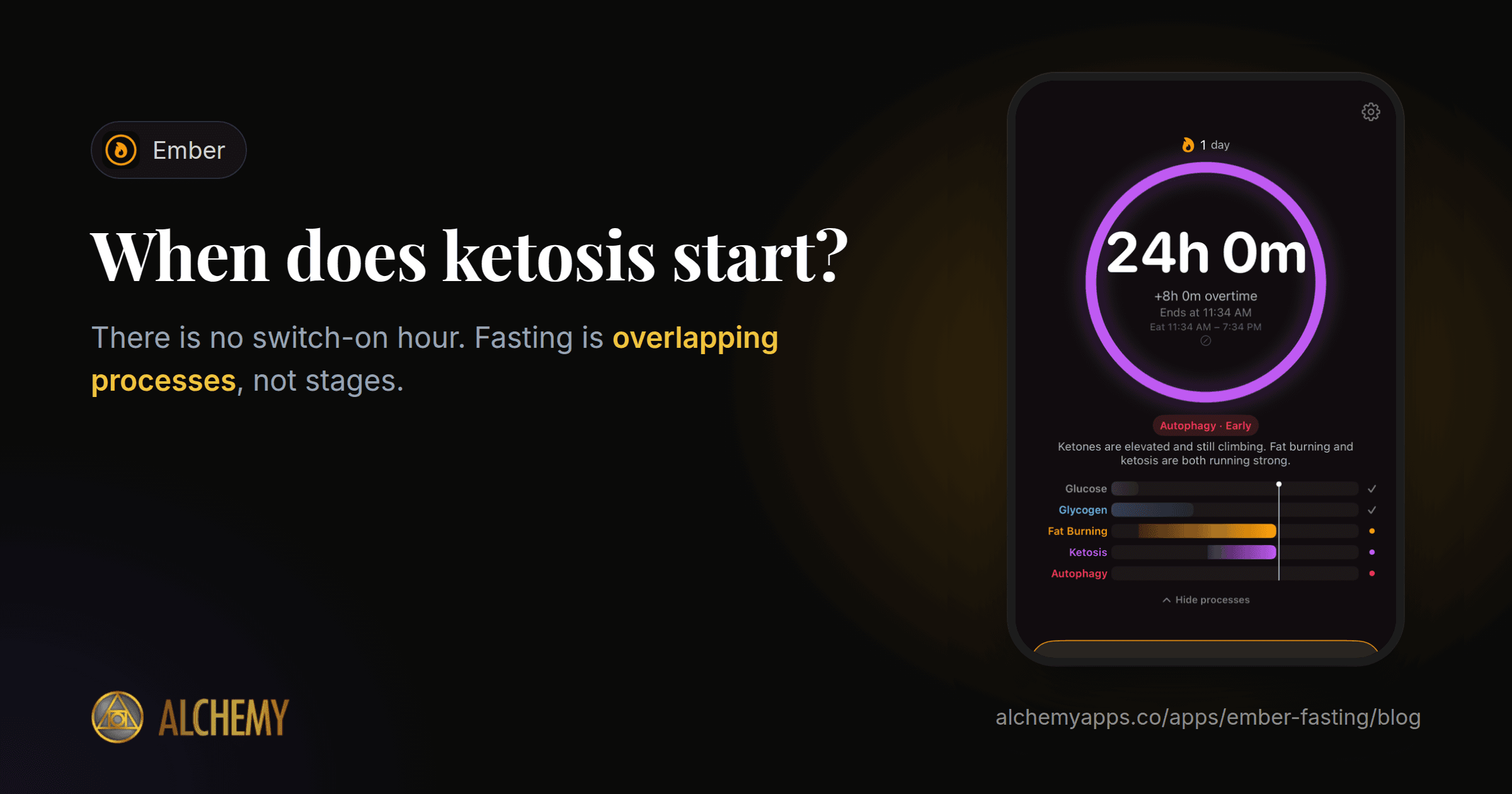
Search "when does ketosis start" and you will find a confident number: 12 hours, 18 hours, 72 hours. They cannot all be right, and in a sense none of them is. Ketosis does not switch on at a set hour. It builds gradually, alongside other changes, at a pace that depends on you.
This is general information, not medical advice. If you have diabetes, take insulin or other glucose-lowering medication, are pregnant or breastfeeding, or have a history of eating disorders, talk to your doctor before fasting.
What ketosis is
Most of the time your body runs mainly on glucose. When glucose is scarce, your liver turns fat into ketones, which your brain and muscles can use as fuel. Ketosis simply means ketone levels in your blood are higher than usual.
It is a normal response to going without food. It is also very different from diabetic ketoacidosis, a dangerous condition that mainly affects people with type 1 diabetes. In a healthy person fasting for a day or two, the body keeps ketone levels in check.
Why there is no single start time
The trigger is not the clock. It is your fuel supply.
When you stop eating, your body first draws on glycogen, the glucose stored in your liver and muscles. As liver glycogen runs down and insulin falls, the liver makes more ketones. So the real question is how fast you use up that stored glucose, and that varies:
- What you ate before. A large, carbohydrate-heavy dinner refills glycogen and pushes ketosis later. A lower-carb day brings it earlier.
- How active you are. Exercise uses glycogen faster. A walk or workout during a fast tends to move things along.
- Your body. Size, muscle mass, age and metabolic health all change how much glucose you store and how quickly you burn it.
- How often you fast. People who fast regularly often find ketone levels rise sooner than on their first attempts.
A rough timeline, with wide error bars
Treat these as typical ranges, not targets:
- After an overnight fast (around 12 hours): ketones are usually only slightly raised. Your body is still mostly using stored glucose.
- Around 16 to 24 hours: for many people, ketones rise to the level often described as light ketosis. Some get there sooner, some later.
- Two to three days: ketones are usually clearly raised, as glycogen stores are largely used up.
- Longer fasts: levels keep rising for several days. Fasts this long should only be done with medical supervision.
If you have read what happens at hour 12 of a fast, this fits the same picture: hour 12 is when fat burning is clearly under way, not when ketosis begins.
Overlapping processes, not stages
Many fasting apps show a fast as a ladder: fat burning, then ketosis, then autophagy, as if you finish one rung and step onto the next. Your body does not work like that.
These processes overlap. Fat burning is already rising when ketone production picks up. Ketosis keeps building while other changes, such as autophagy, begin to ramp up in the background. Nothing switches off when the next thing starts. A more honest picture is several dials turning up at once, each at its own pace.
That matters for how you fast. If you think ketosis starts at exactly hour 18, hour 17 can feel like failure. It is not. You are partway along a gradual curve.
Can you tell if you are in ketosis?
Not reliably by feel. Some people notice fewer hunger pangs or steadier energy later in a fast, but that is not a measurement. If you want a number:
- Blood ketone meters are the most accurate home option.
- Breath meters are convenient but less precise.
- Urine strips are cheap, but they become less reliable as your body adapts.
For most people doing 16:8 or 18:6, measuring is optional. Consistency matters more than chasing a reading. If you are still choosing a schedule, read 16:8, 18:6, 20:4 or OMAD: how to choose.
How Ember shows it
Ember is built around this idea. The fasting timer is free, with no account. Ember Pro adds live metabolic tracking that shows fat burning, ketosis and autophagy ramping up together, each with its own intensity, instead of a single stage label. Tap the info icon during any fast to see what is going on. These are estimates based on typical patterns, not readings from your body.