

 Today's Pills
Once you take five or more medications, keeping track stops being simple. Each one has its own time, its own rules about food, and its own look. The longer the list, the easier it is to miss a dose or take one twice.
Here is a way to bring order to it.
This is general information, not medical advice. Do not change when or how you take any medication without talking to your pharmacist or doctor.
Step 1: Write the whole list down
Start with one complete list. For each medication and supplement, write:
- The name and strength.
- How many, and how often.
- Any instructions: with food, on an empty stomach, not with another medicine, at bedtime.
- What it is for.
- Who prescribed it.
Include vitamins and supplements. They count, and some interact with prescriptions.
Step 2: Ask your pharmacist to review it
This is the step most people skip, and it is the most useful one. Take the list, or the bottles themselves, to your pharmacist and ask:
- Are any of these doing the same job?
- Can any of them be taken at the same time, so I have fewer times in the day?
- Which ones must stay at a set time, and which have some flexibility?
- Is there anything here I should not take together?
In the US, if you have Medicare Part D and take several medications, you may qualify for a free, full medication review through your plan. Ask your plan or your pharmacist.
Step 3: Group doses into a few anchor times
Most people do best with three or four fixed points in the day, tied to things they already do:
- Morning: when you make coffee or brush your teeth.
- Midday: with lunch.
- Evening: with dinner.
- Bedtime: when you plug in your phone.
Fit each medication into one of these, following the instructions from your pharmacist. Fewer, fixed times beat many scattered ones.
Step 4: Make each one easy to recognise
With a long list, pills start to look alike. A weekly pill organiser helps you see at a glance whether today's doses are taken. Noting each pill's colour and shape on your list helps when you refill a bottle and the generic looks different.
Step 5: Set reminders that actually reach you
A reminder only works if you notice it.
- One reminder per anchor time, not one per pill. Four alerts a day get attention; twelve get ignored.
- Make sure they get through Focus and Do Not Disturb. Here is how to make medication reminders break through Focus mode.
- Mark each dose as taken, so you can check later instead of guessing. "Did I take it?" is the moment double doses happen.
Step 6: Keep the list current
Update the list every time something changes, and bring it to every appointment. If you see more than one doctor, it may be the only place your whole regimen is written down.
How Today's Pills handles a long list
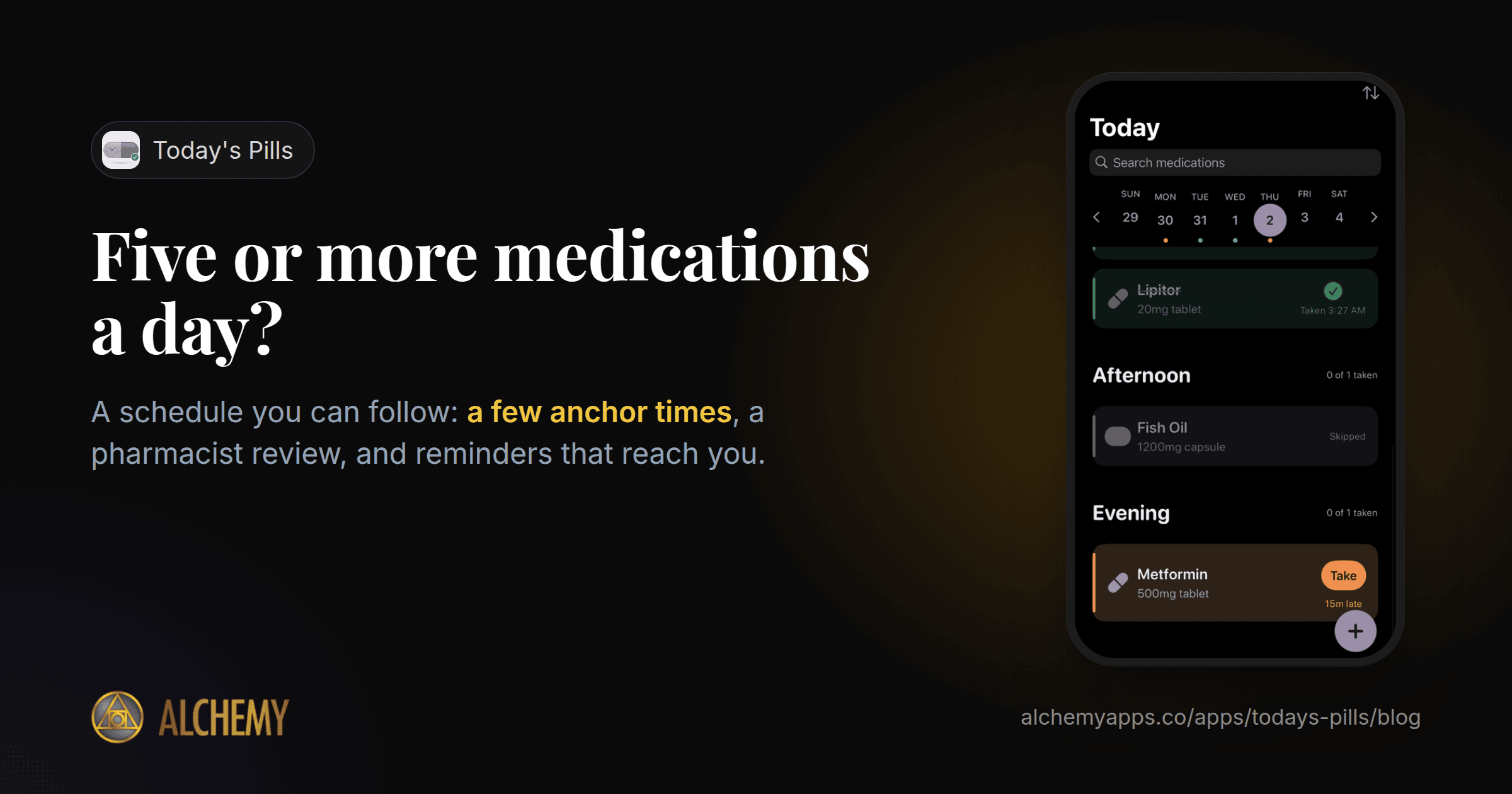
Today's Pills shows your day as a timeline, grouped into morning, afternoon, evening and bedtime, and you mark each dose with one tap. Reminders are Time Sensitive, so they come through Focus modes once you allow them. You can record each pill's colour and shape, and mark medications as Critical, Standard or Low so the ones that matter most stand out. You can also log doses from Siri or the Shortcuts app.
The free version covers up to five medications. If your list is longer, Pro covers unlimited medications and adds escalating reminders that repeat until you mark a dose as taken, a full adherence calendar and exportable reports to share with your doctor. Pro is $2.99 a month, $14.99 a year or $24.99 once, with a 7-day free trial. Your data stays on your phone, with no account.
Missing doses even with a good system? Read why you forget your medication.